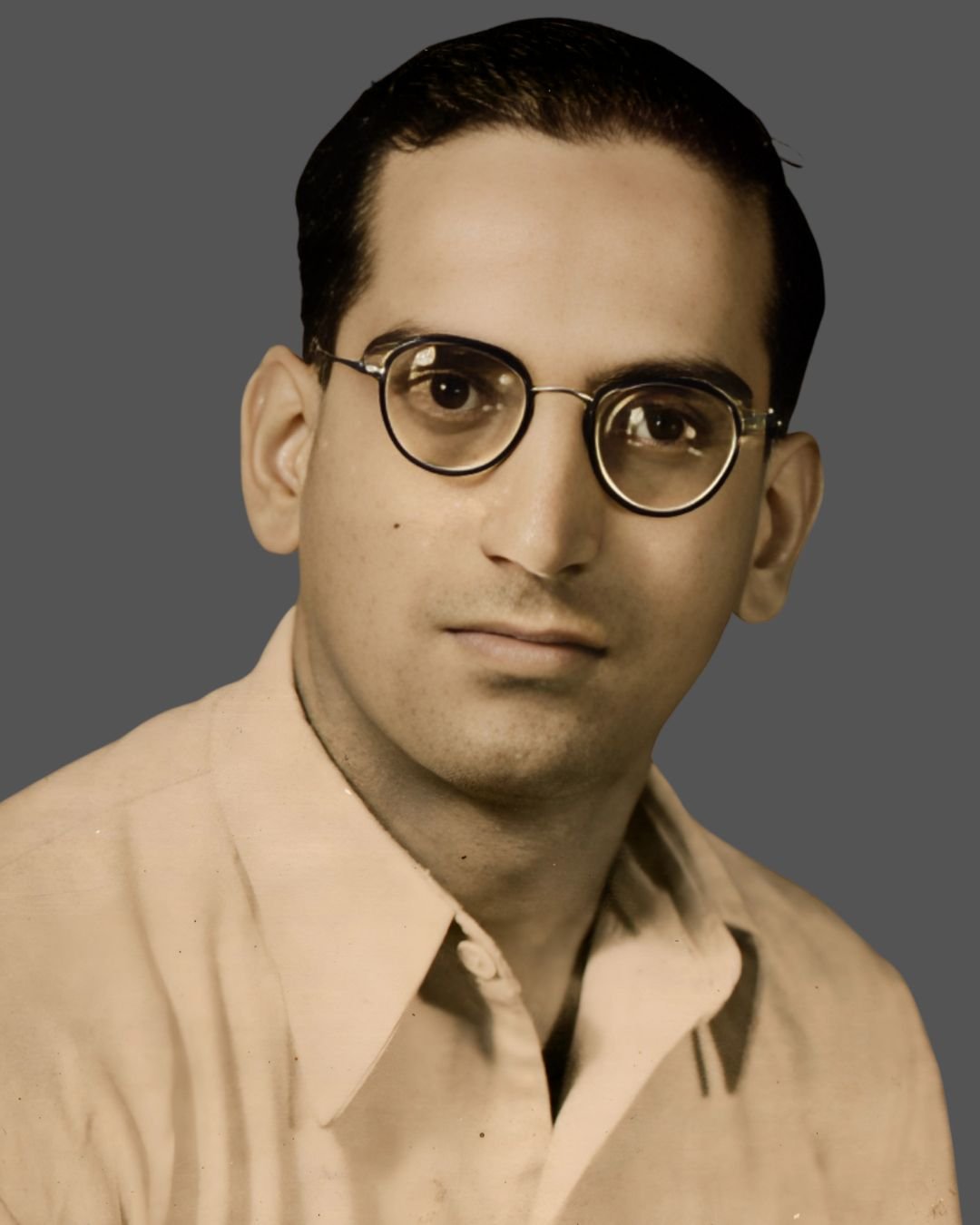
Dr M. L. Dhawale, a pioneering homoeopath, teacher, and researcher who transformed homoeopathic education and practice in India. He revived the HPGA Lecture Series (1957). He authored Principles & Practice of Homoeopathy (Vol. I, 1967) and published a trilogy on teaching, materia medica, and therapeutics (1968). Dr. Dhawale strongly believed: “Patient is the best teacher”, Learning must be experiential and action-based, and students should become: Unbiased observers, skilled clinicians and independent thinkers. He innovated teaching methods by introducing Action-learning and case-based discussions, Peer learning and participatory education with emphasis on responsibility and clinical sensitivity.
He established the Institute of Clinical Research (ICR) in 1975.
Since then, the MLD Group of Organisations has developed a comprehensive and dynamic educational framework aimed at nurturing competent, confident, and scientifically oriented homoeopathic practitioners. Rooted in the visionary principles of Dr M. L. Dhawale, the approach integrates formal academic programs with rich, practice-based learning experiences.
Formal education includes postgraduate training such as the M.D. (Hom.) programme and structured certification courses, while informal learning is fostered through continuous medical education (CME), case-based group discussions, symposia, and long-standing study groups across India. The emphasis remains on experiential learning, guided by the philosophy that real clinical exposure, reflective thinking, and disciplined case analysis are essential for professional growth.
A distinctive feature of the MLD educational system is its focus on standardized clinical practice through tools like the Standardized Case Record (SCR), enabling systematic observation, analysis, and research.
His pioneering “Tri-coordinate Approach“, which balances the needs of the Learner, the Patient, and the Knowledge, remains the bedrock of our educational philosophy.
Complementing its teaching initiatives, the organisation has made significant contributions to homoeopathic literature and knowledge dissemination. Publications include foundational textbooks, teaching monographs, and the Journal of the Institute for the Study of Homoeopathy (JISH), which serves as a platform for sharing clinical insights, research findings, and evolving methodologies. Together, these educational and publication efforts create an ecosystem that supports lifelong learning, fosters inquiry, and advances the standards of homoeopathic practice.
Students are exposed to different hospital departments to develop clinical skills for developing an insight into how to collect, evaluate and integrate clinical evidence which when used appropriately helps in the evolution of a physician. They are also exposed to the health issues in the community to learn the lessons of preventive and social medicine as well as to understand the myriad ways in which illness is prevalent in the community. They are trained in research methodology and biostatistics which enables them to understand how a sound knowledge base is acquired systematically through planning, the facts analysed and later utilized in formulating reliable conclusions. These need to be defended and the resulting knowledge disseminated in a scientific way. Other than clinical subjects, training in soft skills, communication skills and language skills are organised for holistic development of the physicians.
Students are trained to develop sensitivity and an empathetic attitude towards suffering individuals and their family members. They are encouraged to participate in different educational methods like symposia, field visits, conferences, seminars so that the future educationist may propagate the right attitude, skills and knowledge for generations to come.
Evolving a Standardized approach to clinical practice (a common practice in all Institutes of Excellence the world over) Case-based integrated teaching and training (a sound pedagogy in all Postgraduate Education) Principle of Tri-coordinate Care where the teacher is a facilitator and through caring for the Patient and for the Learner (student) is able to demonstrate the care for Knowledge.
All the educational programmes at Dr M L Dhawale Memorial Homoeopathic Institute are based on the Principles of Action Learning. This stipulates that true learning occurs only when the learner plans, acts, observes and reflects on his actions. This helps him to build a repertoire of knowledge which he can own and thus build upon. The thrust is on deriving learning from the clinical work done in the hospital as well as in the community. Lectures, tutorials, group discussions and bed side clinics are conducted keeping case based learning in the centre. Students are encouraged to find the answers themselves through a guided programme. An effort is made to integrate various disciplines so that the whole is delivered and the concept of individualization is gradually made experiential.
Students are exposed to different hospital departments to develop clinical skills for developing an insight into how to collect, evaluate and integrate clinical evidence which when used appropriately helps in the evolution of a physician. They are also exposed to the health issues in the community to learn the lessons of preventive and social medicine as well as to understand the myriad ways in which illness is prevalent in the community. They are trained in research methodology and biostatistics which enables them to understand how a sound knowledge base is acquired systematically through planning, the facts analysed and later utilized in formulating reliable conclusions. These need to be defended and the resulting knowledge disseminated in a scientific way. Other than clinical subjects, training in soft skills, communication skills and language skills are organised for holistic development of the physicians.
Students are trained to develop sensitivity and an empathetic attitude towards suffering individuals and their family members. They are encouraged to participate in different educational methods like symposia, field visits, conferences, seminars so that the future educationist may propagate the right attitude, skills and knowledge for generations to come.
Evolving a Standardized approach to clinical practice (a common practice in all Institutes of Excellence the world over) Case-based integrated teaching and training (a sound pedagogy in all Postgraduate Education) Principle of Tri-coordinate Care where the teacher is a facilitator and through caring for the Patient and for the Learner (student) is able to demonstrate the care for Knowledge.